Mr. Murphy’s Beer

Image

Moving into an old house is a bit like marrying into a family where instead of mingling blood, we mingle ink on property records. We redecorate; we inhabit kitchens, living spaces and bedrooms; we rarely think about the others who washed dishes, entertained guests, and slept within the same walls. However, every now and then we do, as I was reminded that my house used to be the Murphy’s place.

Pre-1962 Ballantine XXX Ale Can

Ballantine XXX Ale; matches the can I found.

Most original parts of this 1915 working-class bungalow have been replaced. The latest was the front porch. Over the years, I kept an eye on mortar crumbling and bricks sliding off piers through a basement window placed oddly (for the view), but fortunately (for monitoring) underneath the porch. Besides deteriorating structural elements, I saw only dead leaves, a green plastic flower pot and a couple of brown bottles, happily hidden from street view by lattice.
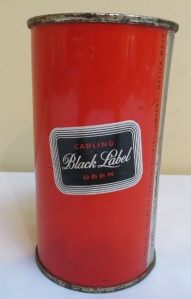
CCarling Black Label flat top can pre-1962.

Carling Black Label flat top can.

When the contractor crew finished digging for the new footers, they said they’d set aside some glass they thought was interesting. After they left, under cold, damp and darkening skies, I gazed upon the “interesting” heap of naked beer bottles and rusted cans. Ugh. I’d rather read about archaeology than do it, but this was my house history, even if it wasn’t news that folks enjoy drinking beer on the front stoop, – and sometimes opt for the most expedient disposal method. I got myself an empty recycle bin and began the filthy work.

Every bottle was dirt-smeared gray. Big clots of wet soil and decomposing stuff clung to some. Whitish bits… ghosts of product labels stuck to some bottles. Then a brown bottle with something green on the neck caught my eye. Though the paper was eroded at the edges, it showed a clear image of a harp behind lettering that read, Imported Guinness Stout.

Lower down on the face of the bottle, about two thirds of an off-white, oval label remained. There was the harp, in finer detail, but just half of it with “Trade Mark” barely legible. Around the edges in bold…

GUINNESS FOR… STOUT  ST JAMES’S GAT…DUBLIN

…and inside that…

Bottled by

Guinness Exports, Ltd

Liverpool, Eng.

So among the American beers before pop-top cans (after 1962) was an Irish import, Guinness Foreign Extra Stout, also known as FES, and described by the company,

“Foreign Extra Stout is a beer like no other. The most full-flavoured of all. Singular and striking. Uniquely satisfying. Brewed with extra hops and roasted barley for a natural bite. Bitter and sweet. Refreshingly crisp.”

Good advertising-speak for a bitter and high alcohol (8%) brew. Though all the other labels had worn away, enough bottles matched for me to know that Dennis Murphy (1895-1977), the former owner, identified strongly with his Irish roots, – and liked a drink with a kick.
Guinness.FES.RoundLabel-1950s.2

Dennis Maurice Murphy was born in County Kerry, came to the US in 1915, fought in World War I and became a US citizen. He worked to support his parents before he married Anna, another Irish immigrant, in 1920. He made tires before he landed a job with the city fire department. On his pay, the Murphys were able to buy a house and raise three daughters. Dennis topped off his career as District Fire Chief, and well deserved to savor his special brew on occasion.

I tried to attach dates to Mr. Murphy’s Guinness FES. I studied label images never finding an exact match (though the image above is close), and what I read on history of Foreign Extra Stout in the United States was inconsistent. Some say the product was not popular when it returned here as Prohibition ended and  World War II stopped its import again until 1956 and it was withdrawn shortly afterwards. Perhaps liquor purveyors in this Irish “Hungry Hill” neighborhood, purchased extra stock to keep on hand for good customers  – like Mr. Murphy.
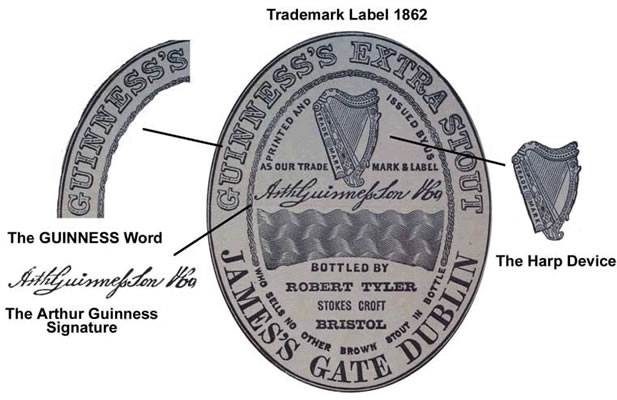
Guinness Trademark

Sources:
Guinness Foreign Extra Stout http://en.wikipedia.org/wiki/Guinness_Foreign_Extra_Stout#cite_note-FAQ-3

Guinness in America https://sites.google.com/site/jesskidden/guinnessinamerica

Beer Cans http://www.rustycans.com/HISTORY/history.html

Guinness Collectors Club http://www.guinntiques.com/brandidentity.aspx

Guinness Company Site http://www.guinness.com/en-gb/thebeer-fes.html

A Bottle of Guinness Please; by David Hughes http://books.google.com/books?id=_tOZqDtYv9QC&pg=PT132&source=gbs_selected_pages&cad=3#v=onepage&q&f=false

 

One Band of Brothers

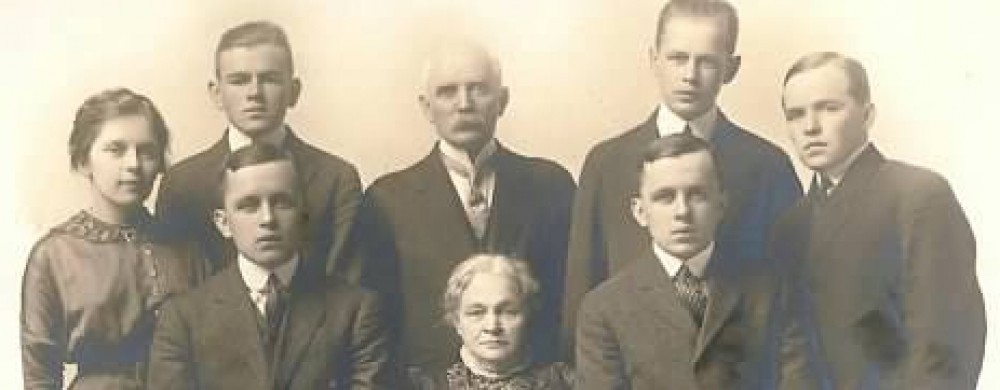
November is the appropriate month to let you see the full image of this blog’s current header  featuring my great grandfather and four of his five sons in uniform in 1918.

Five men in uniforms stand in front of  a large tent at Camp Devens, Massachusetts in 1918.

Click for full size

They are at Camp Devens, Massachusetts, better known as Fort Devens, but originally a temporary spot for quick training military troops from New England. The likely scenario is that the boys were awaiting, or had received orders to ship out to their respective duty stations.

Their widowed father, John F. Roane, Sr., made the journey from Lowell to say goodbye and every man looking toward the camera was acutely aware that war meant this might be the last photograph they would ever take together.

I read warmth and pride on the face of my great-grandfather, who is dressed in his US Post Office uniform. The three army enlistees look appropriately serious, but, under the seaman’s cap, John Francis Roane, Jr. looks kind of excited to me.

When John registered in the 1917 draft, he was a single man employed as an ice cream tester, which sounds like a dream job to me, but John may have wanted work with a bit more weight. He certainly found it, as he served on a submarine chaser out of Newport, Rhode Island.

John’s twin brother, Francis Roane, (on the other side of John, Sr.) had more reason to look serious look. His year-old son died of meningitits in 1916, and he was  supporting a wife and infant daughter as a machinist in the US Cartridge factory at draft time. The army sent him overseas.

In 1921, Frank went back to Europe with a group of American Legionnaires who were feted by the king of Belgium. Frank famously struck up a conversation with the monarch himself (Albert I),  who remarked he liked Frank very much. The incident became legend of “the Peach,” as he became known in Lowell. There is plenty of evidence that Frank Roane shook off his early tragedy and knew how to have a good time.

Paul Roane is the short fellow on the end in the cloth cap and was the eldest of this generation of Roane men. When he registered for the draft, he was unmarried, and a secretary at the offices of the Harvard Brewery.  I know little about his service, but that he was proud of it, as he had been elected commander of American Legion Post 87.

James P.H. Roane, Sr . is the tall man on the left in this shot and my grandfather. I have not delved into his service record yet. He was  single and out on the road as a representative of the Loyal Order of Moose, and in registered for the draft in Pittsburgh, Pennsylvania. Though, like his older brothers, he was  a member of the American Legion, I suspect his military experience wasn’t  satisfying.

I recall my dad, James P.H. Roane, Jr., telling me that his father advised him to enlist in 1942, the year he graduated high school, rather than wait to be drafted, because he would have  no power to choose the job he’s do. Consequently, my  father enlisted in the US Army Air Corps, the forerunner of the Air Force, and was a flight instructor stateside for the duration.

We must not forget the service of women. My dad’s sister was a WAVE, which stood for Women Accepted for Volunteer Emergency Service, but the branch was officially, the US Naval Reserve (Women’s Reserve), and I’m delighted to report she recently celebrated her 90th birthday.

An Orphans’ Story Gets a Happy Ending

I knew my  Granduncle Paul and his wife Lena (Dawson) Roane had an adopted daughter from the tree my “Uncle’ Paul’ sent me with all he knew of Roane family history. As it turns out, Paul and Lena Roane  made a home for two girls, who were hardly  strangers, – they were Lena’s nieces.

In 1919, Lena’s sister, Loretta, married Frank L. Vesey, a veteran of the Great War (WWI), lately returned from France.[1] -Frank moved in with the in-laws[2] on Claire Street, and 10 months after the wedding, they added a daughter, Mary Dorothy, to  the Dawson household. Little Loretta came along in 16 months and, not quite 18 months later, there was Francis Leo, Junior. Seven days after the boy’s birth, the mother of three was dead.[3] The Lowell Sun of April 30, 1923 reported:

Mrs. Loretta (Dawson) Vesey died yesterday at her home, 39 Claire street, following a short illness after the birth of a baby boy. Her age was 25 years. She was born in this city, the daughter of John and Mary J. (Deignan) Dawson, and was a most estimable young woman. She was an attendant of St. Patrick’s church, and a member of the Married Ladies sodality connected with the church. She leaves her husband, Frank L. Vesey; three children, Dorothy, Loretta and Francis Vesey; her parents, two brothers Thomas and Joseph, and one sister, Lena.

The  father, Frank Vesey, probably thought he had overcome the worst things life would throw at him. He’d known the loss of infant siblings, and his own mother’s death[4] when he was eight.  He’d only stuck out four years of grade school and may have suffered from dyslexia.[5]and then he experienced the horrors of a world war. When Loretta was taken from him, he was not yet 30, and completely unprepared to raise three little ones, that included a week-old baby.

Aunt Lena, no doubt, had a hand in caring for her nieces  from their infancy, and surely loved them as her own, but Lena was a 25-year-old working woman, an operator with the telephone company, whose income would have contributed to the support of the extended family.  Her father, John Dawson was 65, a laborer with the sewer department, who’d had health problems.[6] Lena’s mother, Mary, died the next year, – literally, of a broken heart.[7]

but what happened in that house after Loretta’s death?

Did the grief-stricken Frank immediately pack off the children to the orphanage? Was the family forced to make the decision  after grandmother Mary Dawson’s died? Was the parish priest involved in the process? At any rate, two of the Vesey children were inmates of St. Peter’s Orphanage on Stevens Street in 1930, while their big sister, Mary D. Vesey, was living in the Dawson house on Clare street with  Lena and Paul Roane.

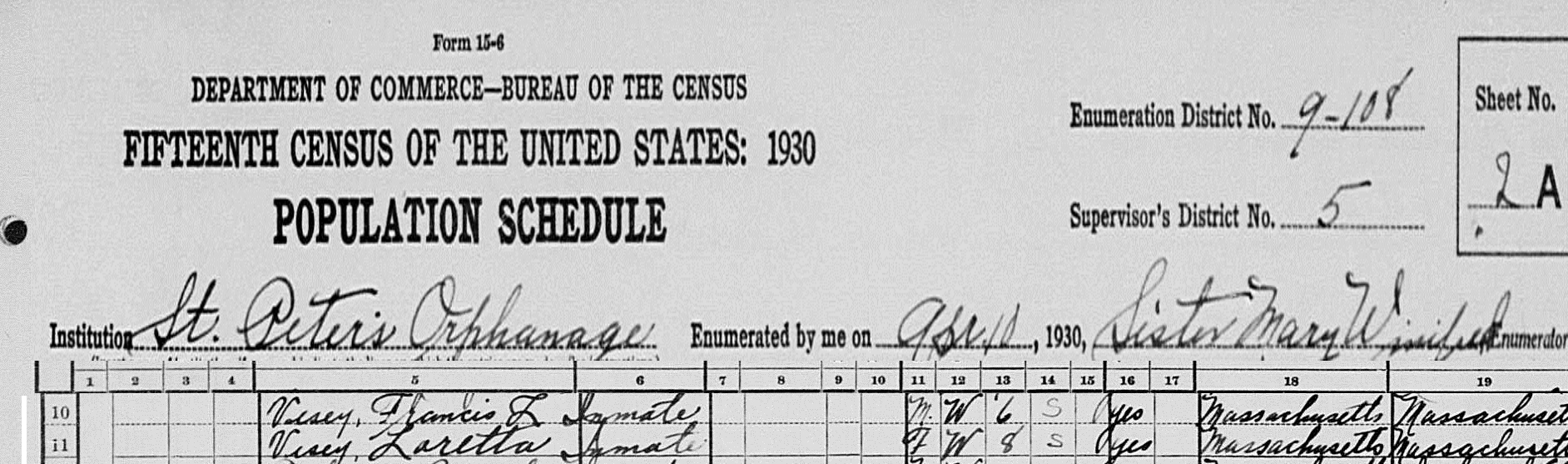
By 1935, Paul and Lena were in a house on Washington Parkway they owned, according  to the 1940 census.  The couple  had created  a home for  now-grown nieces, Dorothy, 19, and 18-year-old Loretta who had taken the Roane name. While I was delighted to discover the sisters reunited, the image of the 1930 census sheet  filled in by Sister Mary Winifred’s neat hand haunted me. What had become of that little boy, Francis L. Vesey? Last weekend, I found out.

This excerpt from the 1930 US census shows the Vesey children, Loretta, 8 years, and Francis, 6 years, inmates of St. Peter's Orphanage.

A descendant of Frank’s brother, James Vesey, discovered my online tree and was surprised to learn Frank had two older daughters, Mary Dorothy and Loretta. But what she knew that I didn’t, was Frank Vesey married again, the widow, Alice Kane. In 1940, Frank and Alice are right there in Lowell with the three children they had together, Joseph, Pauline and William, the children from Alice’s first marriage, Robert, Helen and Dorothy Kane, and 16-year-old Francis Vesey, the son Frank lost for a time. I was greatly relieved to see  the motherless boy, at last, in the bosom of family.


[1]  Francis Leo Vesey, Sr. was awarded a Purple Heart; he served as army private in a machine gun battalion.

[2] The 1920 US census shows the parents, John and Mary Dawson, Lena (AKA Elizabeth M. Dawson), Loretta V. and Frank L. Vesey enumerated at the family home on Claire Street.

[3]  The cause of death for Loretta Veronica (Dawson) Vesey  was “Septic Pneumonia (Puerperal Septicemia),” common after anesthesia due to lesions in the trachea, which suggests she may have delivered in a hospital, though she died at  her parents’ home.  [See http://en.wikipedia.org/wiki/Puerperal_sepsis%5D

[4]  Catherine Vesey gave birth 13 times in 17 years of marriage, she died of eclampsia, the last child stillborn and buried with her. (Downton Abbey character, Lady Sybil Branson, died from eclampsia, though her baby survived.)

[5]  Frank Vesey’s WWI and WWII registration cards show he had terrible handwriting and in 1942 he reversed the last two digits of his birth year, writing “1849,” rather than 1894.

[6] The Lowell Sun reported that John Dawson had a “slight operation” at Lowell Hospital in 1915.

[7]  Mary (Deignan) Dawson died on October 1, 1924 of “Mitral insufficiency,” a heart valve malfunction that modern medicine calls Mitral regurgitation (MR).

Treason!

With the current events focus on the US government charging whistleblowers, journalists and other leakers of embarrassing information with “aiding the enemy,” and threatening dire consequences, I thought it timely to mention my family tie to a man who was executed for treason.

I had a cousin in colonial New York named Elsje Tymens. She was a wealthy widow in 1663 when she married a German bachelor and son of a clergyman, Jacob Leisler. Over the next thirteen years, Jacob and Elsje built connections in business and government, accrued wealth, and added seven little Leislers to the household.  Jacob was a merchant, captain of the militia, and appointed by the courts to administer estates and other property matters.  A devout follower of John Calvin’s brand of religious reform, he identified with the (French Protestant) Huguenot community.

Image 

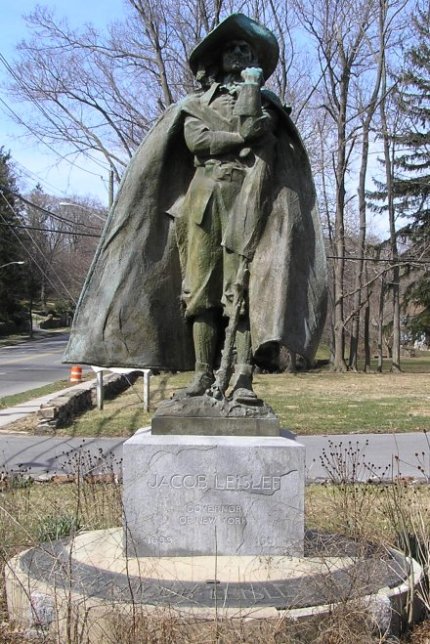
Statue of Jacob Leisler in New Rochelle, New York,

courtesy of Wikimedia Commons.

In 1685, England’s Charles II passed into history and his brother, James II (also James VII of Scotland and James II of Ireland), a Roman Catholic, succeeded him to the throne. To govern the Dominion of New England, James appointed Edmund Andros to sit in Boston, and Francis Nicholson,  lieutenant governor, was assigned to administer the province of New York. Their authoritarian style of rule made both men intensely disliked by the colonists.  Nicholson proclaimed the inhabitants of the former New Netherland (taken by England in 1664),  “a conquered people” who could not “claim rights and privileges as Englishmen.

Across the Atlantic, political factions were so alarmed by King  James’s policy of religious tolerance and his ties to France, that they invited William III, the Dutch Prince of Orange, to invade with his fleet (and his English wife, Mary). James was deposed in a coup known as the Glorious Revolution.

When the news reached American shores, it sparked  a popular uprising against Governor Andros in Massachusetts, and New York’s militia rebelled and forced Nicholson to yield Fort James, which controlled New York Harbor.  The next day,  a council of militia officers asked Jacob Leisler to take command. A few weeks later, a delegation from Lower New York and East Jersey chose Leisler as the province’s commander-in-chief, to act on behalf of England’s new monarchs, William and Mary, until a new governor was legitimately appointed.

Not all New Yorkers were pleased. In his rise to prominence, Jacob Leisler had made enemies that included his in-laws, the powerful Bayards and Van Cortlandts.  Diplomacy was not his strong suit. An anti-Leisler faction coalesced in Albany, and grew dangerously.

In late 1690, William III commissioned Colonel Henry Sloughter as his new governor, but Sloughter’s ship was delayed and his lieutenant governor, Ingoldesby, arrived first.  Ingoldesby demanded Leisler turn over the fort and governmental reins  to him, but, because he lacked the proper papers, Leisler refused.  Even when Sloughter made it to New York, Leisler remained suspicious, and took his sweet time before he surrendered and to his cost. Leisler’s reward for accepting the management and  defense of New York in the name of King William III, – was his arrest on charges of treason.

Jacob Leisler, his right hand man and son-in-law, Jacob Milbourne, and eight other men were tortured, tried, convicted, and condemned to be “hanged, drawn and quartered, and their estates confiscated.[1]” The panel of judges was stacked with a significant number of anti-Leislerians.

Governor Sloughter seems to have had some misgivings about the result, as he wrote a letter to King William about the matter. However, in it, he trashed Leisler, did not include trial transcripts, and failed to mention the death sentence. Also, the court refused the request to send the condemned to England for an appeal.

It’s been written that Governor Sloughter was bribed, that he was drunk, – perhaps, he was both when, at the instigation of Leisler’s enemies, he signed the death warrants. Leisler’s only ‘luck’ is that he avoided being drawn and quartered, was “merely hanged til ‘halfe dead’ then beheaded[2]” as was his son-in-law, Jacob Milbourne, on May 16, 1691.  None of the others convicted were executed.

Petitioners to London who included  the younger Jacob Leisler, won a hearing before the king. Within a year of their execution,  Leisler, Milbourne, and the remaining  prisoners were pardoned.  Parliament later passed a bill that would return the property stripped from Leisler’s heirs, and which was approved by the king in 1695. But it was 1698 before the family estate was restored, and the bodies of Leisler and Milbourne were moved from the dirt beneath the gallows and laid to rest in the yard of the Dutch Reform Church.

Scholars today recognize  Leisler’s Rebellion as a precursor to the American Revolution. It was a power struggle of middling folks against an entrenched elite, – not treason. That’s something to think about as we Americans celebrate the 237 anniversary of  our national ‘treason,’ – independence from England.

Wishing all my readers a wonderful Fourth of July!


[1] McCormick, Charles H (1989). Leisler’s Rebellion. Outstanding Studies in Early American History. New York: Garland. ISBN 0-8240-6190-X.p.357.

[2]  Voorhees,  David William, Remembering Jacob Leisler, The New York Genealogical and Biographical Newsletter, (New York: The New York Genealogical and Biographical Society, Spring/Summer 2002), p. 29.

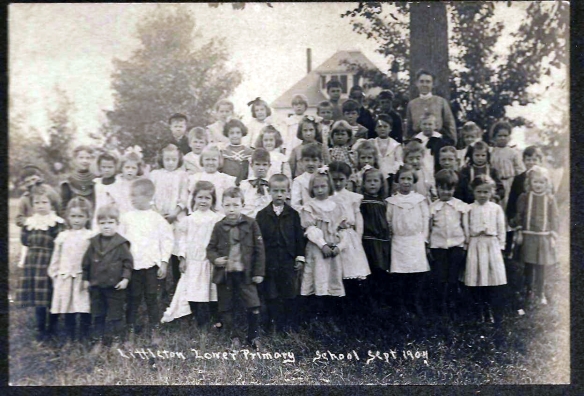
1904 Class Picture – Littleton, Massachusetts Lower Primary School

Image

1904 Class Picture - Littleton, Massachusetts Lower Primary School

One of these students is my grandmother, Edna Mae Keirstead (1898-1988). Her forebears were forced to flee from their farms in upstate New York during the American Revolution. At the end of the 19th century, Keirsteads from New Brunswick traced ancestral footsteps backward to the United States.

If anyone out there recognizes the teacher, or other children, please get in touch and/or feel free to copy and share the image.

Of Cofflins and Rohans

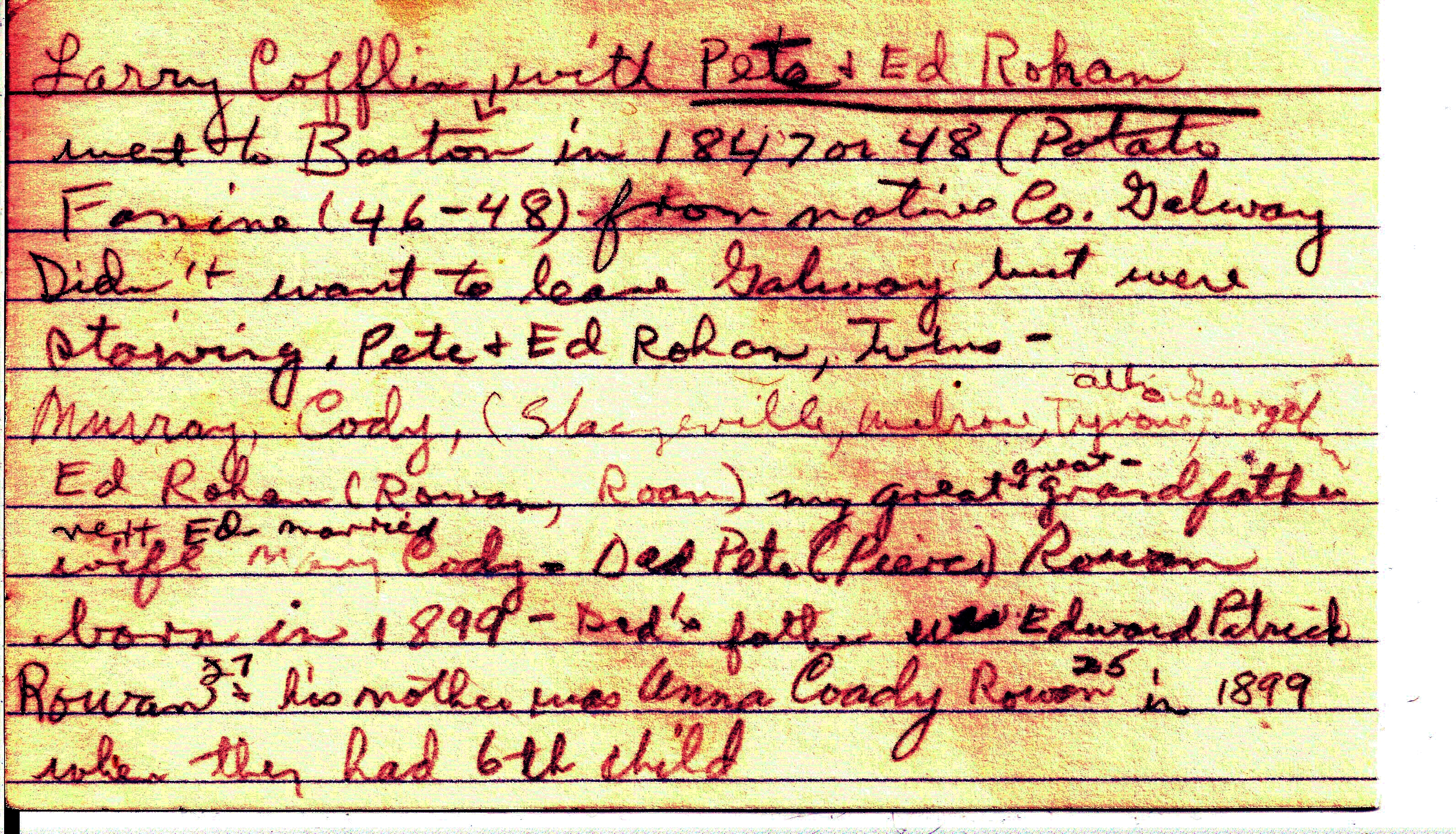
A few years ago I got an email from cousin John O’Connor who had recently cleared out his elderly mother’s Florida beach house. In the process, he came across an index card that most folks would have tossed away without a thought, and, fortunately, John  thought about it. He scrutinized his mother’s  faded and cryptic notations and realized he had 3X5 inch version of 19th-century Iowa family history.

ROHAN-J.OConnor.mom

Image of faded original doctored to make it easier to read.

When he emailed me to see what I could make of it, I was intrigued to learn about the Galway trio of Larry Cofflin, Pete and Rohan! But I was frustrated, too.  This information failed to resonate with anything I knew about our shared ancestry.  John’s forbear was Patrick Roane, the brother of  my John P. Roane. Both men married in Lowell, Massachusetts, but while John stayed, Patrick struck out to obtain newly available government land  in Iowa.

Since my initial confusion, I’m happy to relay, I’ve learned a lot.  I discovered more descendants of the Midwest families, and resources that enabled me, at last, to interpret the notes made by John’s mother, Joanne Rowan O’Connor (1931-2013).

In 1950, a book came out that was written by Leo Ward,  a Monroe County, Iowa native and priest, titled, Concerning Mary Ann. It is a fictionalized account  of the life of his grandmother, Mary Ann (Coughlin) Murray (1859-1957),  and the Irish Catholic settlement known as Staceyville. Ward wielded elements of history, language and character to evoke a unique time and place, – and tells a good tale with authenticity.

However, the first name on the card about Rowan history, is “Larry Cofflin,”  who was Mary Ann’s father. Then, though I’ve found documents using Roane, Roan, and Rowan variant spellings, the only place I’ve found “Rohan,” is in Leo Ward’s book. I believe the excerpts below show that the first lines came straight from Concerning Mary Ann.

            “ON a lovely Autumn day in 1857, the sun hazy in the sky, Larry Cofflin…was en route from Boston to Iowa… as his train of an engine and two coaches steamed and puffed its way out of Chicago and across the top of Illinois and went with the sun toward the Mississippi…

“In his native County Galway, the Potato Famines had hit hard. No fooling about it, no escaping it. The Famines hit people in the stomach. All over Ireland, when it was averaged up, half the people died during and following the Famines of 1846-48

“He had good companions, too, …two sandy-haired, neat-set-up men of his own age were Pete and Ed Rohan. …they were from the same townland with him in Ireland, townies of his…so alike were they in the firm square shoulders, the loose-built bodies, the florid round faces, alike even to the snore. “Brother and brother, twins for it,” thought Larry… With Larry Cofflin they were of one mind, headed west with him to take up land in golden Iowa.”

I believe that well researched fiction can inform us about lives and times of our ancestors. However, even if we know real people inspired characters in a book, it is a mistake to accept those accounts as fact, without careful examination. We are lucky today to have online records easily available that help sort truth from fiction.

Ward’s book describes bachelors traveling together in 1857, but we have documented that Patrick Roane married in 1853 and came to Iowa with his wife and daughter.  But we have strong evidence that Lawrence Coughlin, Patrick Roane and Edward Roane were in league together for on June 3, 1856, each received patents on parcels of abutting land from the Chariton Land office. Census records from 1870 until 1900 show Lawrence Coughlin and Patrick Roan families occupied neighboring farms, but Edward Roane is absent.

However, it is not surprising that Mary Ann Coughlin remembered the names, “Pete and Ed Rohan.” They belonged to her generation of immigrants’ children. The book describes times she shared with the same-age friend, Rose Anne Roan. She was Patrick’s daughter and had brothers, Peter (1863-1942) and Edward (1868-1928). There was also, a set of twin boys, Edward and Lawrence, born to the younger Edward in 1905. These fellows just happen to be brothers of Pierce “Pete” Rowan, whom Joanne O’Connor identifies as her father.

The index card is decoded as part truth and part literary legend, with some mysteries yet to plumb (Were the two Roanes were really twin brothers? What happened to the elder Edward Roane?). And thus did Joanne Rowan O’Connor succeed in passing on a priceless bit of tradition for her children and grandchildren.

Levi Keirstead, Family and Friends?

Image

Levi Keirstead, Family and Friends?

Circa 1900, perhaps, in Littleton or Groton Massachusetts. My great grandfather, Levi Keirstead, sits on the porch rail, – hatless, in work boots, and with bushy mustache and arms crossed over his vest. Most of the others dressed up for the occasion, but what sort of gathering was it?

If anyone recognizes Keirstead (or other) relatives, the house, or anything else, please get in touch!


The Hero Without a Face

Last October, I was a little bit startled to see a message from the Austin, Texas Police Department sitting in my email queue. Once I’d confirmed that none of my kin had gotten themselves into trouble, I realized the inquiry belonged to the opposite end of human behaviors, – it was the search for a hero.  A senior patrol officer wrote,

“Our very first officer to die while serving, was a Cornelius Fahey on March 3rd, 1875.  The only information we really have on him was that he immigrated to the states from Cork Ireland. …He would have been 35 years old at the time of his death.

“I was hoping you knew of the Faheys in Cork and might be able to help. We would love to be able to dig up a picture of Officer Fahey in order to commemorate his service for our city.”

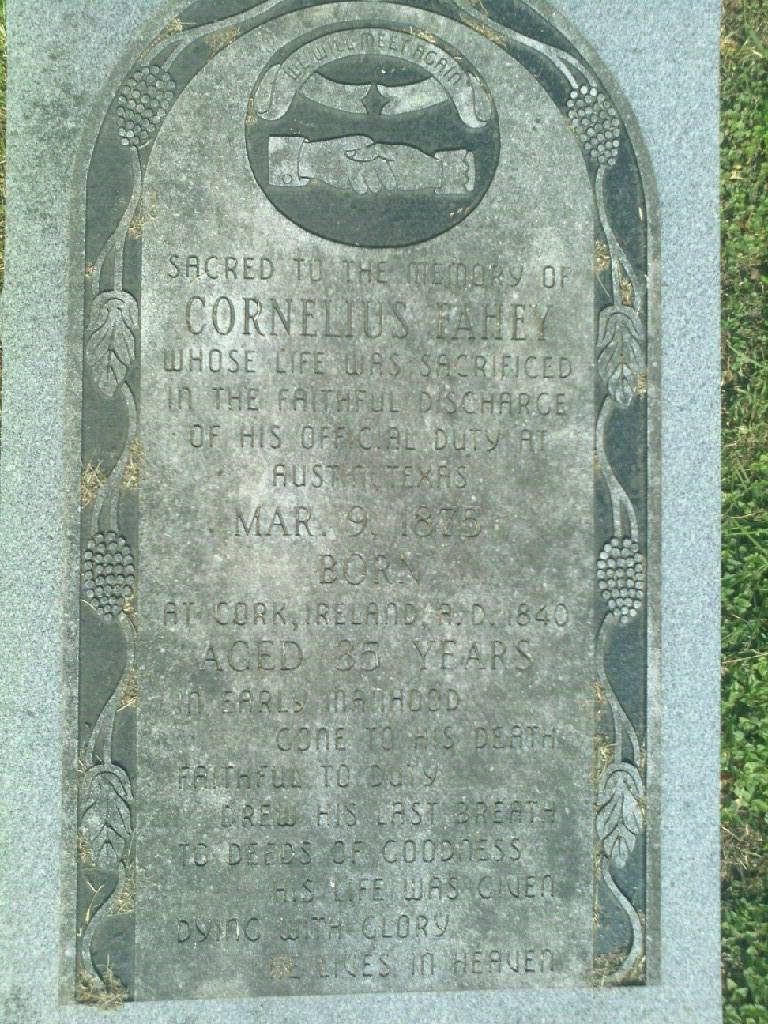
Monument placed at the grave site of Cornelius Fahey in 1997.

This image was contributed by lcommando67 at BillionGraves.com.

Right out of the gate, I knew my Cornelius Fahey was no match. My same-named ancestor was born half a century before 1840, and his only known child in America was from County Galway, not County Cork.  However, like any of the tribe called to genealogy, my pulse quickened and my keyboard fingers itched to discover something that might help the resourceful investigating officer.

It took seconds to pull up a Find-a-Grave record for Officer Fahey. Buried in Oakwood Cemetery, he had a wife and family, and name of the contributor was “C. Fahey,” – possibly a living descendant!  What gave me pause was learning that Cornelius met his untimely end at the hands of a “whiskey-crazed” man named Mark Tine. Transcribed at the website is a lengthy account of the incident from the March 9, 1875 Austin Daily Statesman. Here’s an excerpt:

“On last Sunday night between 12 and 1 o’clock another of those events which come under the head of desperadoism, and which so long have been the curse of this State, occurred in this city. The repose of our own citizens was disturbed by what appeared to be a regular pitched battle, and the sharp peals of six-shooters, and the flashes of fire, smoke and deadly missiles they belched forth, the clattering of horses, feet upon the hard street as the demon incarnate was borne away, all tended to frighten and excite women and children and men as they rushed from their beds to the windows, doors and streets.

” Strange thoughts and forebodings were uppermost in the minds of all, and the general inquiry was- what is the matter? The question was soon answered, for there upon the sidewalk was policeman Fahey shot through the abdomen, and other policemen were following after the assassin who, on horseback, was taking flight up the Avenue shooting at every one who would dare to hail him.”

Holy moley. Contemporary relations of my Cornelius Fahey lived lives less colorful (think soot gray), and much less violent in Lowell, Massachusetts, a city built, literally, to industrial order. Its mills signaled the day’s beginning, the mid-day meal, and quitting time. Lowell’s police department formed in 1830, but no officer was lost to gunfire until 1957. Cornelius Fahey of Austin, Texas lived in a different world, yet his immigrant experience fits a pattern.

As the most despised newcomer group of the 19th century, many Irish men won respect and citizenship through military service during the Civil War (1861-1865). In later years, they began to fill public service jobs, until the Irish cop with the lilting brogue became an American icon.

Records show in March  1866, Cornelius Fahey signed on with Company D of the US 6th Regiment of Cavalry for a three-year hitch, – interestingly, at Boston, Massachusetts. The regiment established its headquarters in Austin and became part of Fifth Military District of Texas. Its mission was to supervise civil authorities in applying federal law, which included pursuing Native Americans and outlaws. These bits from official reports show Private Fahey in the thick of it.

  • February 7th 1867. Austin—Corporal Thomas Casey—Co M 6th US Cavalry—gunshot wound of the abdomen; admitted from camp to regimental field hospital; died February 8, 1867.
  • February 9th 1867. Austin—Pvt Michael O’Callaghan—Co D 6th US Cavalry—shot by a citizen—admitted to hospital February 10; died February 11, 1867.
  • October 1867. … with troops of 6th Cavalry 45 men and 22 Indians. Encounter with Comanche; 3 Indians killed, 1 captured. 19 horses/1 mule/2 revolvers recovered. Remains of 5 citizens killed by Indians buried. 
  • November 8th to 12th 1867. 6th Cavalry from Buffalo Springs, Texas. Troops from the 6th Cavalry 1 officer/25 men and 1 citizen. Passed through Montague and Clay Counties; traveled 120 miles to operate against Comanche.
  • March 7th to 10th 1868. Troops from 6th Cavalry {Co D} 13 men and 7 citizens. Passed through Collins, Hunt, and Grayson Counties. Traveled against Lee’s band of thieves & outlaws in Read Creek Swamp, Collins County. “Indians killed, 2; prisoners, 5 (men)”.
  • April 1 1868. Austin─Private William Burke, Co. B, 6th Calvary, aged 21 years, received a wound to the abdomen from a conoidal bullet. Admitted to hospital and died same day.

Horrific traumas, rendered in spare language, convey a lack of humanity sadly not unique to by-gone times. However, cold and steely-eyed men might still be moved to tenderness.  On April 2, 1868, Cornelius Fahey’s name appeared on a district official statement distributed to the Austin Republican, to Flake’s Bulletin (Galveston), the Army and Navy Journal, and  Richmond, Virginia’s New Nation. Titled a “resolution,” it is clearly an expression of deeply felt grief.

“…our friend and companion William Burk (sic)…most foully murdered in cold blood and without any apparent provocation… we most deeply deplore his untimely end. As a firm friend and companion…and by his uniform kindness and genial disposition has caused his memory to be respected by all who knew him…”

Cornelius re-enlisted at Austin on April 9, 1869 and was discharged, for reasons unknown, on November 30, 1870 at San Antonio. I found him next in the Galveston Tri-Weekly News of Monday, June 19, 1871  among appointments made by Chief of Police, Colonel Hobbs, to the police force.

 Was it during this six months break between soldiering and policing that Cornelius Fahey married?

Had he come to love the harsh terrain of Texas as well as the green island of his birth?

 Did he envision a future Austin where he and a family might prosper?

Signs were there. In 1871, Austin became the westernmost link of the Houston and Texas Central Railroad. Trade and construction boomed. Gas street lamps appeared in 1874 and the first streetcar line began operating in 1875. But it was March that very year, a bullet fired by a drunken desperado killed Cornelius Fahey at the age of 35. Thus, his name entered into history.

What touches me most deeply about this tale, is the brotherhood of police officers whose enduring respect launched an effort to put a face to the names of all its fallen comrades. I am sad that I could not help.

We cannot know whether Officer Fahey ever had a photograph made in his lifetime. If he had, time and the elements may have taken their toll. If an image survived, who could identify it with certainty? I hope that descendants, or a local historian may yet be able to help.

In the absence of an image, we might sketch Cornelius Fahey in the mind’s eye. Army enlistment records put his height at 5 feet and 9 1/2 inches. He had brown eyes and dark hair. Odd for an Irishman, his complexion was noted as dark. — I imagine the Cork native’s fair skin burnished by the Texan sun.

Please visit the Austin Police Department Officers’ Memorial website where you can read modest and moving salutes to all of Austin’s brave officers lost from 1875 to 2012.

When Quitting Solved a Mystery

My father taught us that Irish Americans should be proud and sing “When Irish Eyes are Smiling” every St. Patrick‘s Day. Because  the genealogy bug me didn’t bite until long after his death, I hardly knew more than that about my Roane roots. For help, I wrote the only elder Roane I knew, “Uncle Paul,” who was, unbeknownst to me, my dad’s cousin. Paul Roane, Senior graciously provided all the names and dates he knew. He even created hand-ruled trees. So I learned the founder of my paternal line in Lowell, Massachusetts was John P. Roane, who  died on November 28, 1869 when he was 38 years old.

Armed with sketchy facts in living memory, I dove in and harried city clerks and librarians in places far and wide. I fleshed out the Lowell families. I contacted and reconnected with “lost” cousins.  However, I was confused by my inability to document that precise date of John P. Roane’s death.

I pictured my ancestors as typical specimens of the 19th-century poor and struggling who were drawn to the world-famous mill city. In 2003 I made a pilgrimage to the consecrated ground of St. Patrick’s Cemetery that held so many weary Irish bones. I prepared myself for the possibility there was no Roane marker to see, knowing stones were (and are) expensive, but after making inquiries, an administrator marked a map, handed it across the counter, and waved me cheerily out the door.

Two minutes later, I stood flabbergasted. An embarrassingly immodest granite monument rose up from the Roane family plot (photo below). Okay, I’ll push  aesthetics aside; the discovery must be assessed within its historical context. During the Victorian era, ostentatious displays told beholders you were successful. Though my Roanes always lived in working-class dwellings (some still stand), – in death, they communicate a powerful desire to be remembered as people of substance and importance. But I digress.

Photo of the Roane monument at St. Patrick's Cemetery in Lowell, MA

Roane Monument at St. Patrick’s Cemetery in Lowell, MA

Beneath a crown with a cross thrust through it, carved into the polished stone, you can read:

JOHN P. ROANE

DIED NOV. 28, 1869

AGED 38 YRS.

ERECTED BY

MARY O’NEIL

DIED MARCH 24, 1919

AGED 83 YRS.

Here was the reason John P. Roane was not forgotten, but he wasn’t buried here. This plot was purchased in 1894, 25 years after his death. Frustration flooded over me. I’d searched in Lowell, other towns and cities, in state repositories and online databases with no result.  I still had no death record, no funeral notice, no obituary. I burned to know exactly where he came from, what happened to him, and why. But that day I couldn’t think of a place I hadn’t already looked. John P. Roane’s end and origins were lost to history and it was time for me to move on.

I shifted my research focus to John’s widow, Mary Hurney. She moved on with her life by marrying a Civil War veteran named Patrick O’Neil in 1873. The remarkable Mary out-lived him, too. (In fact, Mary out-lived all but one of nine children and every one of her 13 siblings).

Head shot of Mary (Hurney) Roane O'Neil (1836-1919) from a group photograph taken in Lowell's Marion Studio around 1913.

Mary (Hurney) Roane O’Neil.

Patrick O’Neil suffered a myriad of debilities arising from his military service. Doctors declared him unable to work and he collected disability payments in his last years. After he died in 1896, Mary applied for her widow’s benefit.

The federal government used fill-in forms for these applications, so when I ripped into the NARA* file, I was surprised to find pages of handwritten testimony. Like any claimant, Mary had to prove that a US soldier was dead and that she had been his wife. Mary produced death records for Patrick O’Neil, his two former wives, and a marriage certificate. Legal difficulties arose because Mary had no death record for first husband, John Roane.  She needed sworn witnesses to the facts surrounding John Roane’s death. Then WHAM! it felt like a lightning strike** when I recognized the surnames, JONES and HILLARY. I read…

I was a cousin of the John Roane who was the first husband of the above named Mary O’Neil and went to Ireland with him…

Bits of information I’d collected over years, but could never tie in, began falling into place…. Witnesses at baptisms were often relatives…  There was no death record, because John did not die here.

…That before leaving Lowell he was in ill health and the physicians recommended a sea voyage and… that he did not meet with the health that he thought he would derive from the change and constantly grew worse…

Tuberculosis (TB), also known as consumption, or phthisis, was the scourge of the Roane family and remains a potent killer. Before Robert Koch discovered its cause in 1882, treatments included the ‘work cure’ (eating basic food and performing manual labor in the outdoors). And if you had money enough, you might take the ‘travel cure’ to experience a restorative change in climate.

I can’t know that John Roane had TB, but he was treated for an ailment like it. Though a grocery store owner since 1859, at the birth of daughter Sarah in 1868, John gave his occupation as mason ( hard labor). Then the cousins’ testimony that  they accompanied him to Ireland in the of spring 1869 fits the pattern of TB ‘cures’ of the time.

These facts we know because we were intimate with him and with him constantly until he breathed his last…and was buried in Colmanstown, Galway Co. Ireland.

Lastly, a cousin told me Aunt Mollie said the Roanes came from Athenry…  When I searched online for  Colemanstown, it turned out to be a tiny settlement. The nearest town to it is Athenry.

And so a genealogy mystery was solved in a way that reminds me of a stargazing trick. If you stare straight at some celestial objects, you cannot see them at all.  However, when you avert your vision, that is, look slightly side-wise, – they magically pop into view.

——-

*This cemetery was referred to as the “Cath yard” by Yankee record keepers.

**National Archives and Records Administration

***Lightning did strike Patrick O’Neil, – but that’s a story for another day.

Roane’s Pennsylvanians and Hot Dance

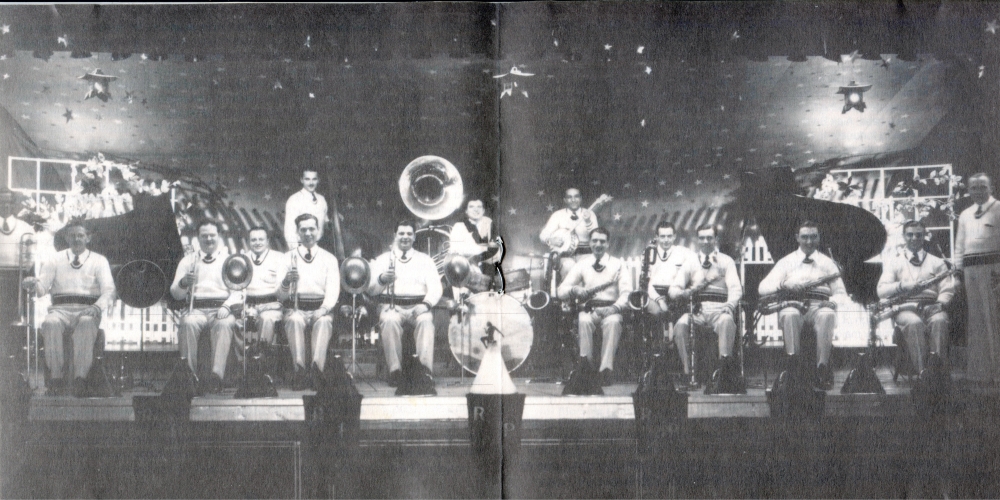
Roane's Pennsylvanians

Frank Roane is at the far right of his band, Roane’s Pennsylvanians.

A recent link I stumbled upon at Archives.org brought to mind an exciting episode in Roane history that occurred when I had barely begun my journey.

I received a telephone call from an Al Giordano, who was a fan of early 20th century dance bands. He told me that BMG Music, when it acquired RCA Victor, inherited its properties. He had recording sheets from Studio 1, 24th Street, New York, dated January 28, 1932 and June 2, 1932, for sessions with Roane’s Pennsylvanians. In order to put together a new CD issue, he needed some authoritative information about Frank Roane. Wow.

I put out a cousin distress call and was able to get  my aunt to confirm that her Uncle Frank, AKA Francis J. Roane, AKA “Peach” Roane (1893-1942) was a master of ceremonies for weekly dances at the Commodore Ballroom in Lowell, Massachusetts. His signature schtick was delivering this announcement in an English accent,

The next daaance is the last daaance…

(Clearly, you had to be there to get the effect.) A direct line cousin added that some evenings Roane’s Pennsylvanians played the Commodore, Frank’s daughter, Mary Katherine, would sing with the band. Though band leader, there’s no evidence Frank was a musician (he did have the Roane family gift for song). He was rather, a manager and promoter.

In naming the group, I suspect he chose to trade on the popularity of another orchestra known as The Pennsylvanians. Modest soul that he was, he appended his name, created a brand and earned a modicum of lasting fame in music history. The University of Massachusetts Center for Lowell History has a Commodore Ballroom Collection that contains sheet music and photos of  bands that played at there and Roane’s Pennsylvanians is included among the “excellent local bands.” They played regional gigs to popular acclaim, and got that RCA contract.

The CD produced by The Old Masters and issued in 2000, is called, Alex Bartha’s Traymore Orchestra & Roane’s Pennsylvanians. The songs Frank Roane’s band recorded in 1932 are all fox trots in the Hot Dance category. Among the song titles you’ll detect a hint of Harlem / Black culture:

Between the Devil and the Deep Blue Sea
Cast Your Sins Away, Charlie Two-Step
Chinatown, My Chinatown
Good-Bye Blues
Is I in Love? I Is
Sleep, Come On and Take Me
When You and I Were Young, Maggie
We’ve Got to Put That Sun Back In The Sky
Why Don’t You Get Lost?

There were great dance beats, novelty tunes that incorporated scat singing. The Victor label issued records by Alex Bartha and Roane’s Pennsylvanians under the pseudonym, Williams’ Cotton Club Orchestra to expand market appeal. In fact, jazz great, Cab Calloway and His Orchestra also recorded the then new Harold Arlen / Ted Koehler tune, Between the Devil and the Deep Blue Sea.

Click on over to Archives.org and you can listen to Good-Bye Blues.